
63th Annual Meeting of the Society of Thrombosis and Haemostasis Research | February 27 – March 2, 2019, in Berlin
The VFTH e.V. presents research findings obtained from data collected with smart medication:
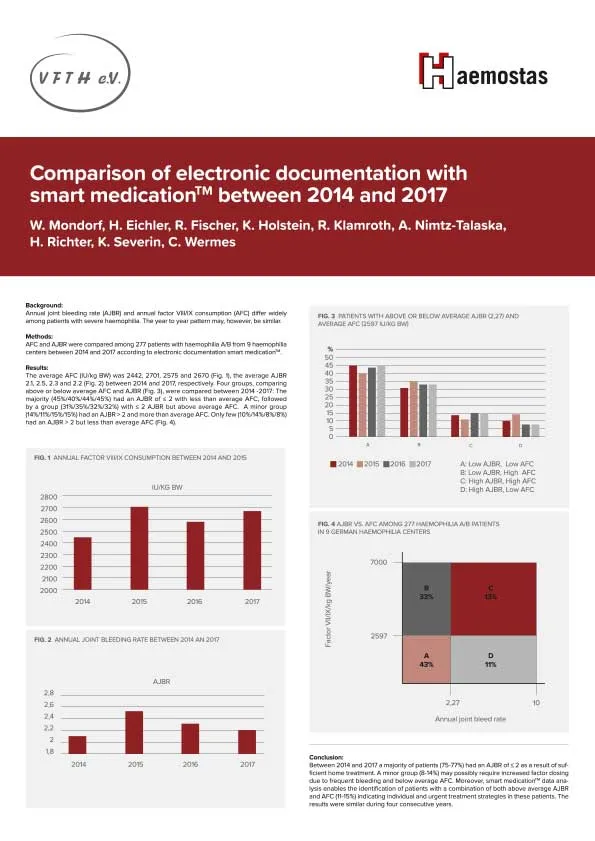
Comparison of electronic documentation with smart medication between 2014 and 2017.
Annual joint bleeding rate (AJBR) and annual factor VIII/IX consumption (AFC) differ widely among patients with severe haemophilia. The year to year pattern may, however, be similar.
W. Mondorf, H. Eichler, R. Fischer, K. Holstein, R. Klamroth, A. Nimtz-Talaska, H. Richter, K. Severin, C. Wermes, VFTH e.V. (Poster number: P03-1)
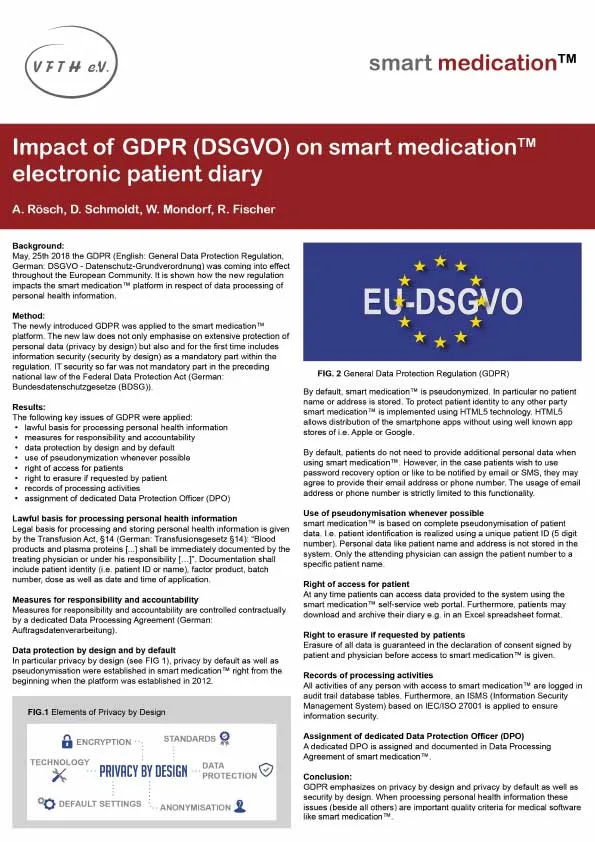
Impact of GDPR (DSGVO) on smart medication electronic patient diary. May, 25th 2018 the GDPR (english: General Data Protection Regulation, German DSGVO: Datenschutz-Grundverordnung) was coming into effect throughout the European Community. It is shown how the new regulation impacts the smart medication platform in respect of data processing of personal health information.
A. Rösch, D. Schmoldt, W. Mondorf, R. Fischer. (Poster number: P09-10)
Published abstract: Hämostaseologie 2019; 39(S1) – DOI 10.1055/s-0039-1680234, opens in a new tab
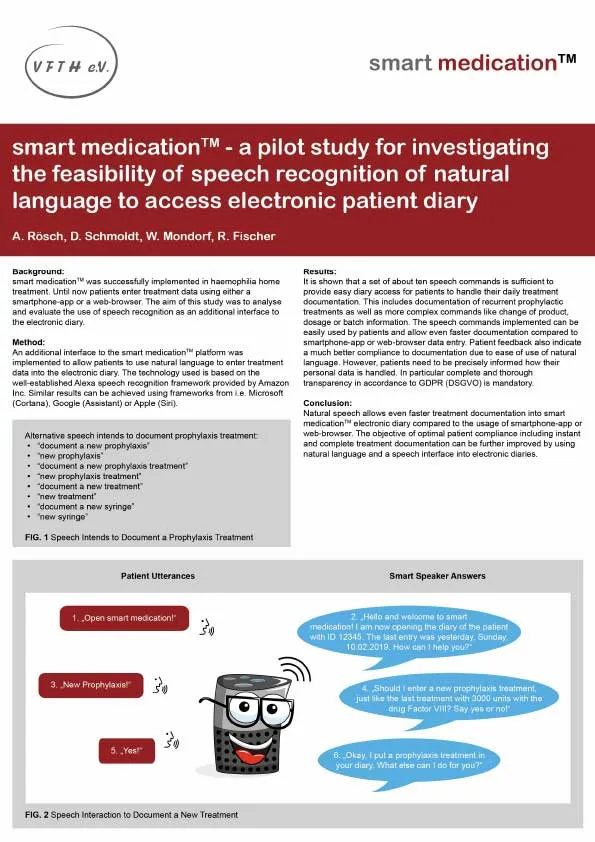
smart medication – a pilot study for investigating the feasibility of speech recognition of natural language to access electronic patient diary.
smart medication was successfully implemented in haemophilia home treatment. Until now patients enter treatment data using either a smartphone-app or a web-browser. The aim of this study was to analyse and evaluate the use of speech recognition as an additional interface to the electronic diary.
A. Rösch, D. Schmoldt, W. Mondorf, R. Fischer (Poster number: P09-9)
Published abstract: Hämostaseologie 2019; 39(S1) – DOI 10.1055/s-0039-1680233, opens in a new tab
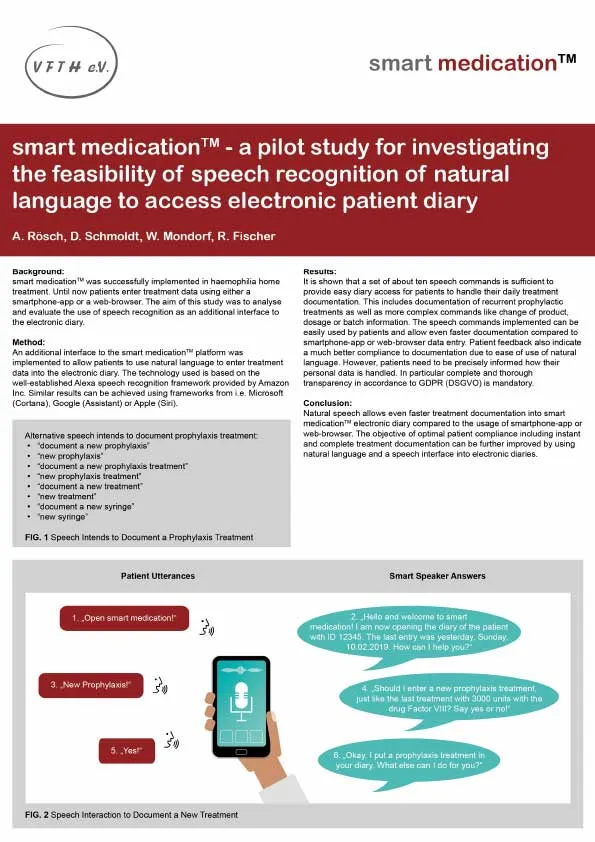
smart medication – a pilot study for investigating the feasibility of speech recognition of natural language to access electronic patient diary.
A. Rösch, D. Schmoldt, W. Mondorf, R. Fischer (Poster number: P09-9)